
Same Market, Different Bets: Inside Three AI Ad Creative Companies
For a project in Professor R. Paul Singh's Marketing Strategies for Startups class at Northeastern, I had to pick a category, choose three companies in it (each with at least $5M in funding), use their products, and figure out how they actually compete. The ad creative generation market is one of the most crowded categories in the AI startup landscape with more than 600 active companies. Fortune Business Insights pegs the 2026 AI video generator market at $847 million, on a path to $3.35 billion by 2034.
The same product, three different outputs
Before reading another marketing page, my team and I gave each platform the same input: a Dr. Squatch product page for their "Lumberjack Lodge" bar soap. We asked each one to produce an ad. Here are the results:
- Creatify produced a UGC-style vertical video with a scripted avatar over pinecone stock footage.
- InVideo gave us an atmospheric, voiceover-narrated edit of someone working with wood.
- AdCreative.ai produced a clean lifestyle clip with a hands-under-water shot and a competitor jab caption ("soap that dries out").
Despite giving the same product info and brief, each platform gave different interpretations of what an "AI ad" even is.
Creatify: the speed-to-ad bet
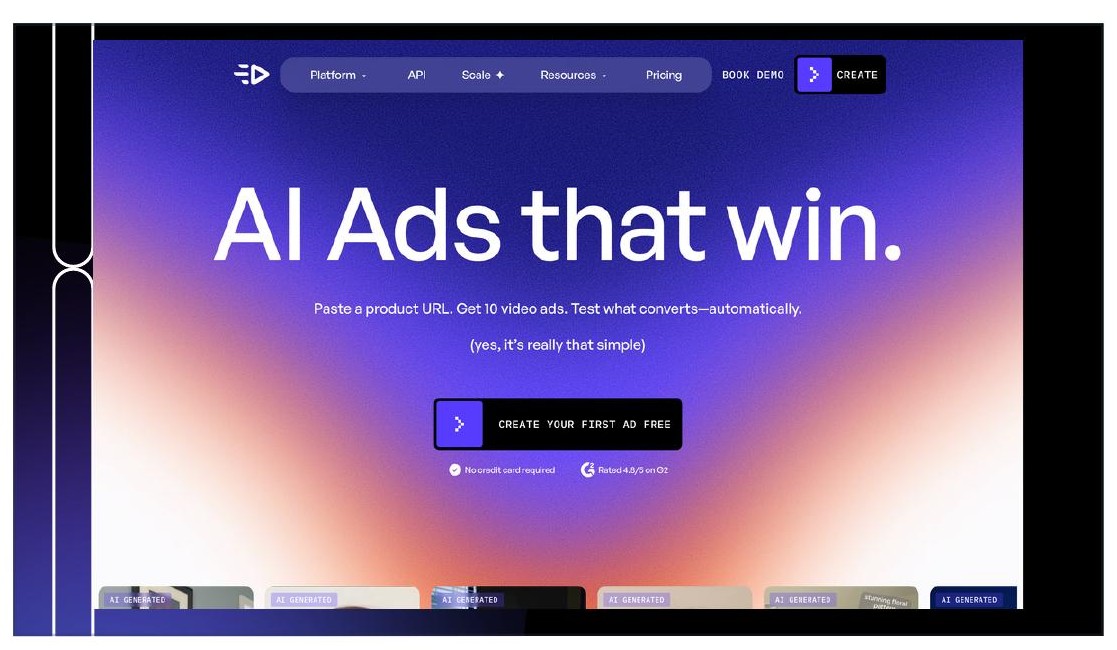
Creatify was founded in 2023 by three engineers out of Meta, Snap, and FAIR, headquartered in Mountain View. It's raised $23M in Series A funding co-led by Jeffrey Katzenberg's WndrCo, sits at roughly $9M ARR, and has 1.5M users with a 4.7/5 G2 rating.
Their pitch is the simplest of the three: paste a product URL, get ten video ad variations in minutes, test what converts. The URL-to-Video workflow is unique to them. Rather than being solely a video creation tool, they focus on being an ad performance engine for marketing teams.
The customer this product was built for is obvious from one minute of using it: a direct-to-consumer e-commerce operator on Shopify, Amazon, or eBay who needs UGC-style ads at volume and would rather skip the creative process entirely. Listed customers include Alibaba, Comcast, and Zumper.
InVideo AI: the creative breadth bet
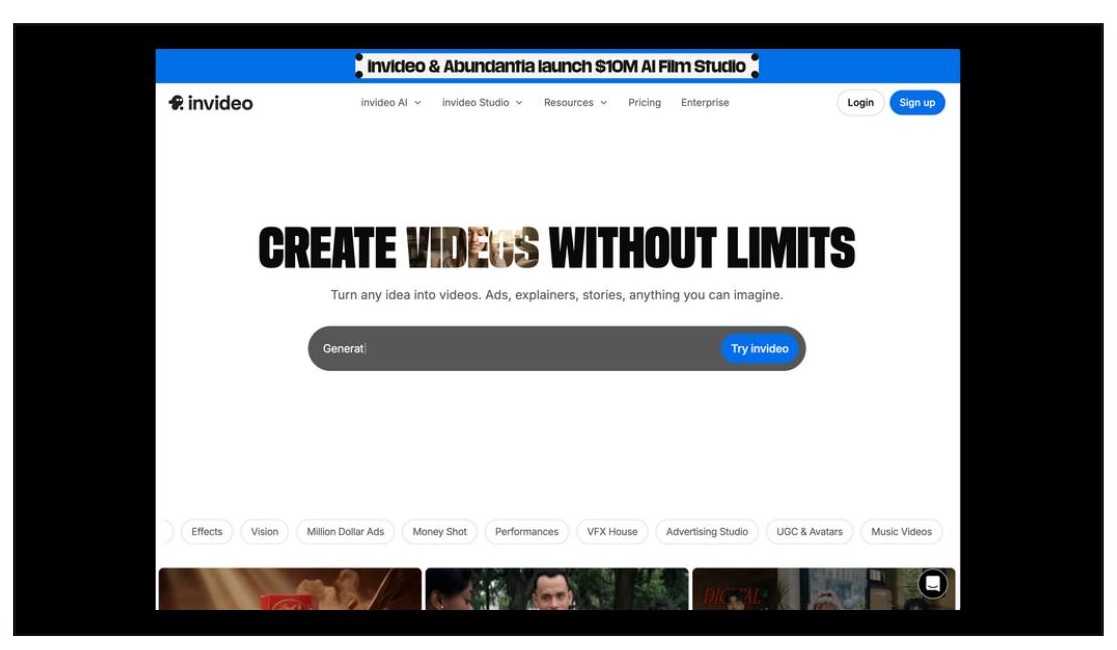
InVideo is the oldest and largest of the three. Founded in 2017 in Mumbai by Sanket Shah, it has raised $52.5M from Tiger Global, Peak XV, and Greenoaks, claims roughly $70M ARR, and counts 50M+ cumulative users.
InVideo is the only B2C player in the cohort, and it shows. The platform handles videos up to 30 minutes long, supports 50+ languages, and bundles 200+ AI models including Google's VEO 3.1. The CEO has said publicly that the company sells "simplicity, not video creation," and the homepage backs that up: "Create Videos Without Limits."
Where Creatify built a tool for one user (the e-commerce performance marketer), InVideo built a tool for everyone. The tent is the broadest in the category, but their positioning disinterests buyers who want depth over breadth.
AdCreative.ai: the data optimization bet
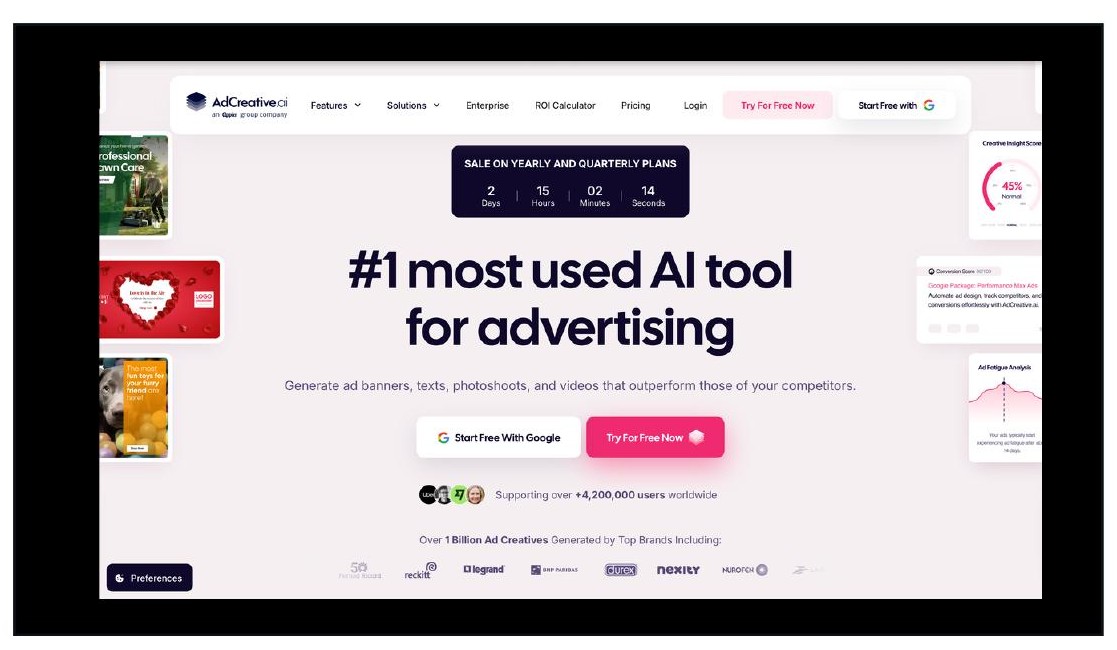
AdCreative.ai was founded around 2021 in Paris by Alexandre Leciel, Yusuf Kaya, and Tarik Ince. It was acquired in February 2025 by Tokyo-listed Appier for $38.7M. At acquisition it was doing roughly $15.9M in ARR with 3M+ users and a 4.3/5 G2 rating.
The differentiator here isn't the creative output. It's the Creative Scoring AI, trained on $35B+ in advertising spend data, which predicts conversion rates before a campaign launches. That positioning ("#1 most used AI tool for advertising") plus the enterprise client roster (Tesco, L'Oréal, Snapchat, BNP Paribas) reveals the buyer: an enterprise marketer who cares more about predicted ROI than about creative novelty.
The acquisition is itself a strategic data point. A 2.4x revenue multiple is on the low side for AI SaaS in this window, which suggests the deal was less about valuation and more about Appier needing the creative layer for its full-funnel AdTech stack.
They don't actually compete with each other
A closer look into the three companies reveals that they live in three different markets that happen to overlap on a category map.
A clean way to see the divergence is to plot them on two axes: how broad the creative output is (video-first vs. multi-format), and how ad-specific the use case is (general creative vs. ad-specific).
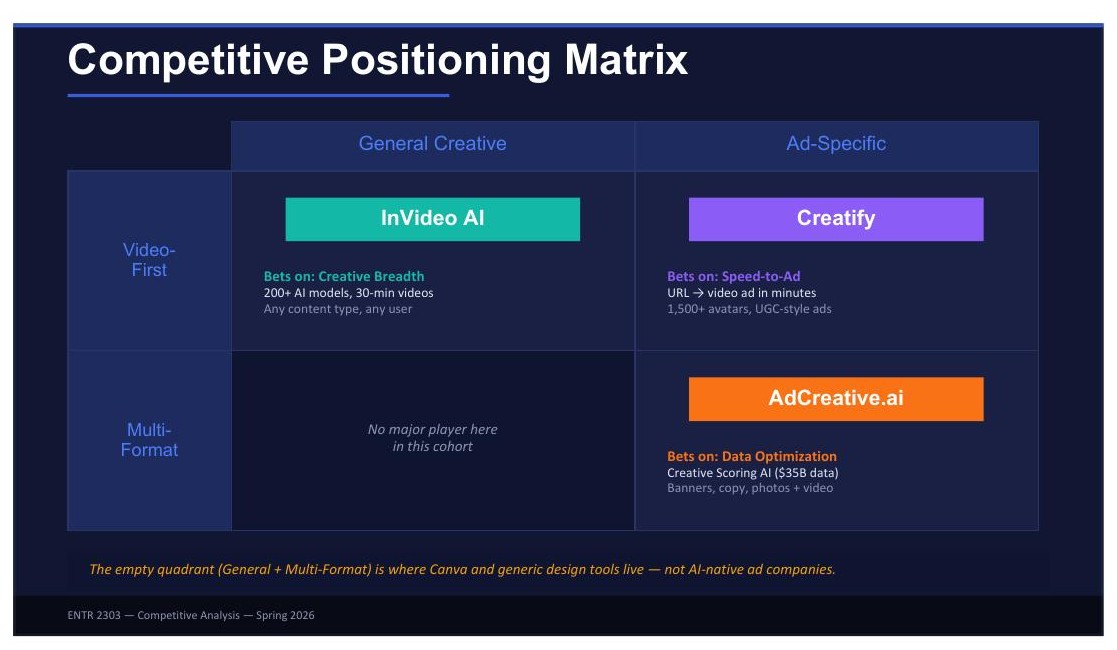
A buyer choosing among the three isn't really choosing among substitutes. They're self-selecting into one of three clusters: "I run e-commerce ads," "I make videos," or "I optimize ad spend at scale."
Two strategic learnings
After using all three products together, I learned two key takeaways from this competitive analysis.
First, segmentation is what makes a crowded category survivable. While all three companies appear in the same a16z market map and have similar offerings, none of them directly compete. Creatify segments by marketing function, InVideo by content creation need, AdCreative.ai by analytics sophistication. Even within a crowded market, these businesses successfully differentiate their brands to effectively reach their target audiences and thrive in their respective niches.
Second, platform-native AI is the unmentioned dominant threat. Meta's Advantage+ AI creative tools have reportedly crossed $10B in revenue and are growing roughly 3x faster than Meta's overall ad revenue. Google Performance Max, TikTok Smart Creative, and Amazon's AI Creative Studio are all building creative generation directly into the ad-buying surfaces themselves. For any startup whose value sits on top of a platform, the incumbent has more conversion data, better distribution, and much lower CAC for any feature it absorbs. A stable position is too expensive to copy or hard enough to replicate such that buying the startup becomes the cheaper option.
What this changed about how I look at my own work
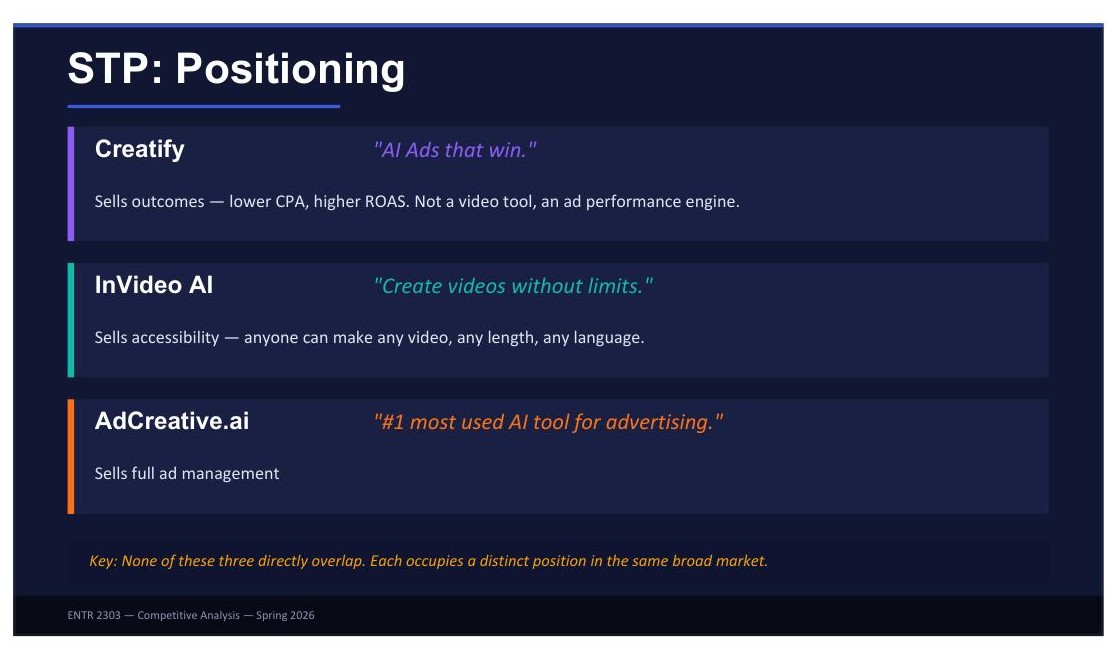
The most useful methodology lesson from this project came from the Dr. Squatch test itself: reading marketing pages tells you what a company says it does, but using the product tells you what it actually values. Creatify's homepage promises "AI Ads that win" and the URL-to-Video workflow delivers exactly that. InVideo says "Create Videos Without Limits" and the product is in fact a sprawling toolkit. AdCreative.ai says "#1 most used AI tool for advertising" and the Creative Scoring AI backs that claim up.
I've been doing go-to-market work for an early-stage AI startup this semester. After running this analysis, the lens I look at that work through has shifted. The marketing page says one thing. The pricing page implies a different buyer. The first sixty seconds of using the product reveals a third positioning. Each layer can do its own version of "what we are," and a buyer can feel that misalignment instantly even if they can't name it.
The strongest startup positioning keeps the homepage, pricing page, and first minute of using the product all aligned. While it sounds trivial, I found it to be the most important part in early-stage marketing where consumer trust and predictability matter.
This analysis was written as part of ENTR 2303 (Marketing Strategies for Startups) at Northeastern's D'Amore-McKim School of Business, with teammates Lissandra Ferrante, Avinash Vinod, and Sarya Mirghani.
Comments
Loading comments…