
A Website Analysis of Creatify and InVideo
In Professor R. Paul Singh's Marketing Strategies for Startups class at Northeastern University, my team analyzed two AI video platforms operating in the same category but pursuing opposite customers: Creatify (B2B) and InVideo (B2C).
What follows is a side-by-side analysis of both websites, structured around the framework we used in class: customer, differentiation, calls to action, top-of-funnel traffic, traffic data, and what each site does uniquely well or poorly.
1. Who is their customer? A homepage analysis
The fastest way to read a startup's customer is to read its homepage. A hero section that does its job tells the right visitor "this is for you" within seconds and tells the wrong visitor "this is not for you" just as fast. Both Creatify and InVideo do this well.
Creatify: "AI Ads that win." for businesses that run paid media
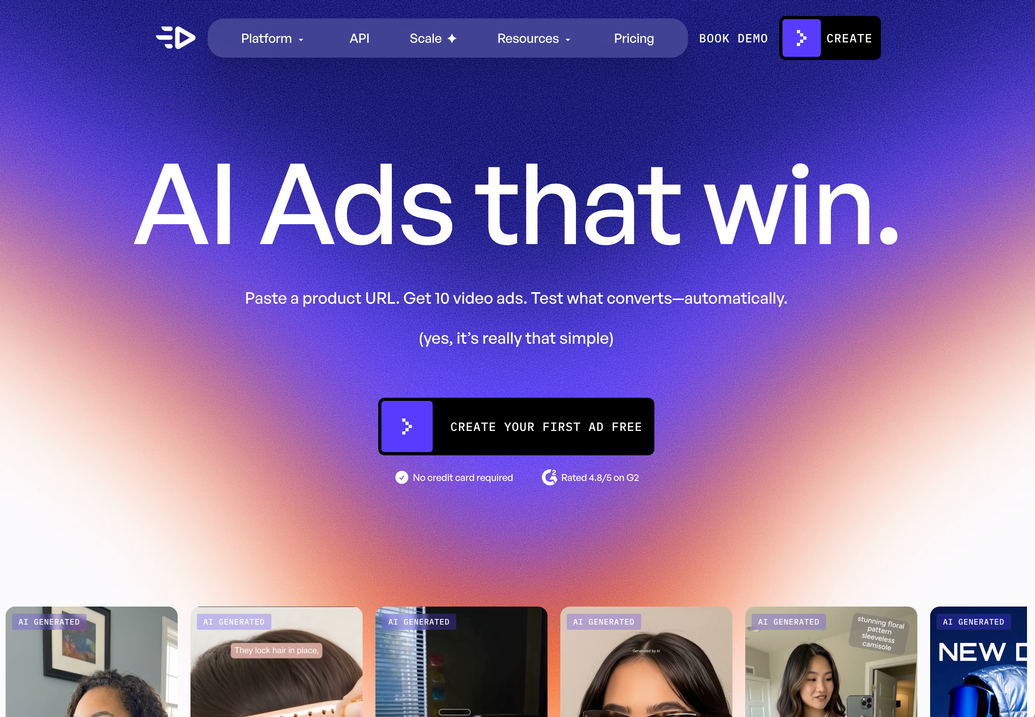
Creatify's hero clearly positions themselves toward marketers running paid advertising. "Win" is how marketers measure things. "Ads," not "videos," signal immediately that this is a tool for businesses running paid media. The supporting line ("Paste a product URL. Get 10 video ads. Test what converts, automatically.") makes the workflow concrete, and "Create Your First Ad Free" removes trial friction completely.
The pricing structure confirms what the headline promises. Creatify's three tiers map onto a buyer's stage of marketing maturity: $19/month Starter for solo e-commerce sellers, $49 to $299/month Pro for direct-to-consumer performance teams, and custom pricing for agencies and enterprises like Alibaba, Comcast, and Zumper.
Even the cheapest tier targets a business buyer who runs ads. The company reports 1.5M+ users, 10,000+ teams, and roughly $9M ARR within 18 months of launch.
InVideo: "Create Videos Without Limits" for creators and small businesses
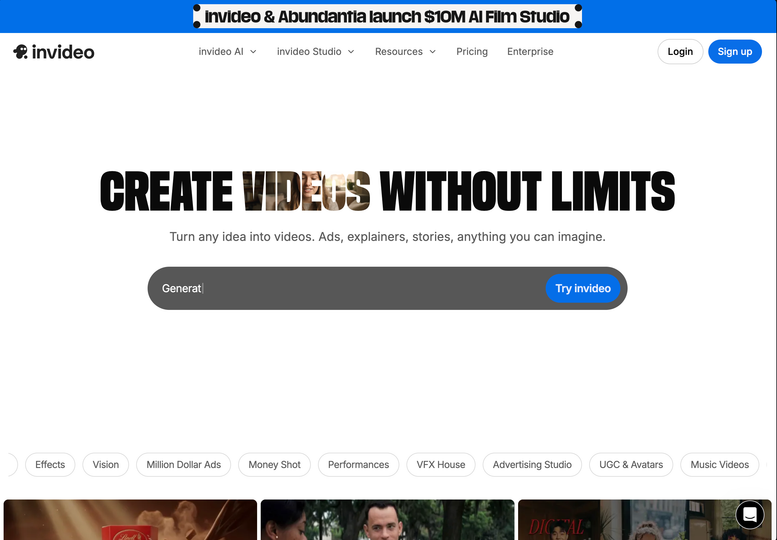
InVideo's hero clearly positions themselves toward an individual with a video idea but basic editing skill. "Create" is inviting. "Without Limits" is aspirational and removes the friction of "I'm not a video editor." There is no mention of ads, business outcomes, or marketing. The prompt-style input bar directly under the headline is the visual analog of the message: type a sentence, get a video.
Pricing again confirms the hero. InVideo starts at free and tops out around $48 to $60 per month for the Max tier. Where Creatify's cheapest plan still costs $19/month and assumes you are running ads, InVideo's free tier is generous enough that 60K+ creators sign up daily.
The numbers reflect the consumer model: 50M+ users, $70M ARR, 8 million videos generated per month.
2. Why this company? What differentiates it?
Creatify's product moat is URL-to-video generation, wrapped in a full ad lifecycle. Paste a product link, and the platform pulls images, copy, and assets from the page to produce ten ad variants. Around that sits AdMax, an end-to-end advertising system that includes competitor tracking, A/B testing, and direct ad launches into Meta and TikTok. No other platform combines video generation, ad testing, and ad launching in one workflow.
InVideo's product moat is multi-model infrastructure. Paid plans bundle integrated access to OpenAI's Sora 2 and Google's VEO 3.1, a combination that would cost roughly $450 per month if purchased separately, into plans starting at $28 per month. A creator can generate the same prompt across multiple state-of-the-art models and pick the best output.
Combined with two products under the same brand (Studio for templates, AI for prompts), a 5,000+ template library, and the generous free tier, this gives InVideo a structural advantage in the consumer creator market.
3. CTA Comparison
Creatify uses a tiered CTA strategy aimed at the free trial. "Create Your First Ad Free" appears in the hero, sticky navigation, pricing page, and footer, so a visitor can convert from almost anywhere on the site. A secondary "Book Demo" path exists for users who want a guided pitch first.
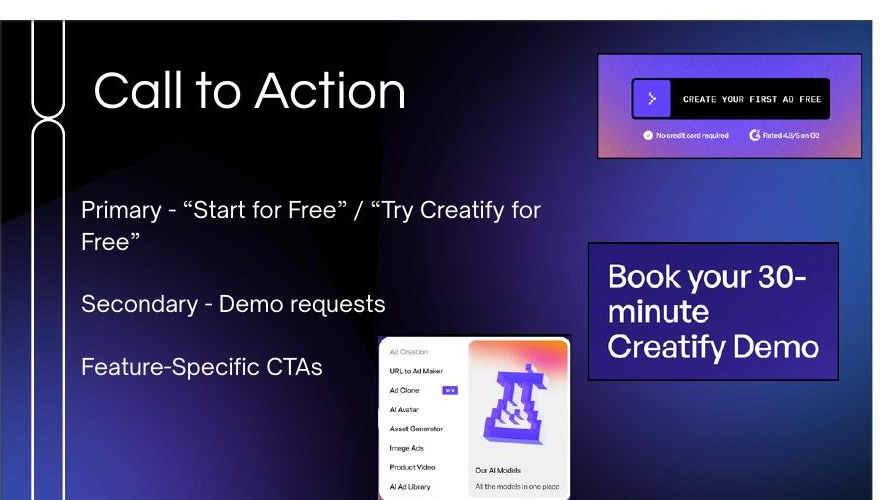
The CTAs work because they are clear, low-friction, and value-focused: no credit card required, browser-based product, first ad in a few clicks.
InVideo uses a split CTA strategy that separates creators from enterprise. Creators get the low-friction path: "Sign up - it's free!", "Try invideo," and "Generate" buttons throughout the site. Enterprise visitors get a different, intentionally higher-friction path through "Book a Demo," which requires a detailed lead-qualification form.
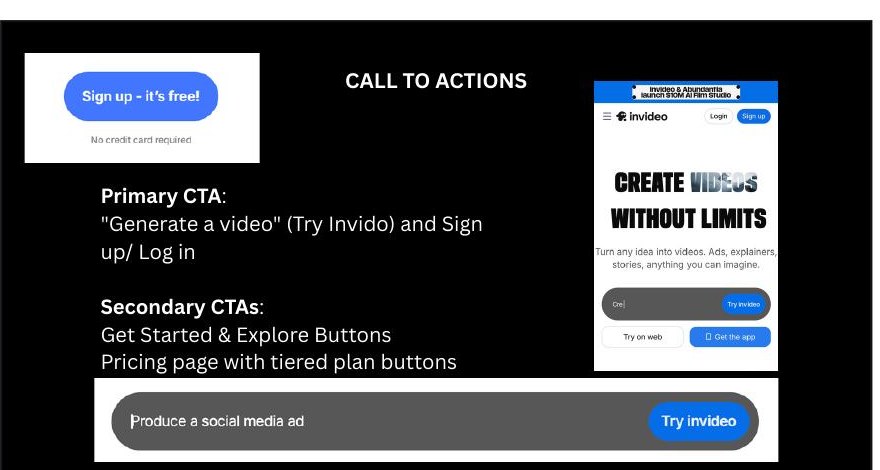
Creators need speed to value. Enterprise prospects are intentionally filtered, because a 50-million-user freemium product cannot afford to send unqualified leads to its sales team.
InVideo also does something Creatify does not: feature-specific CTAs like "Generate" and "Copy prompt" inside the template gallery, so a visitor can browse, copy a prompt, paste, and generate, all without signing up.
4. How do they generate top-of-funnel traffic?
Creatify's awareness funnel is deliberate and broad. The site itself runs an AI ad catalog (visitors browse winning ads by industry), articles and how-to guides, business testimonials with concrete stats, third-party badges, and media features from Fast Company and Bloomberg. On social, the focus is heavy on YouTube tutorials and demo walkthroughs aimed at the performance marketer audience.
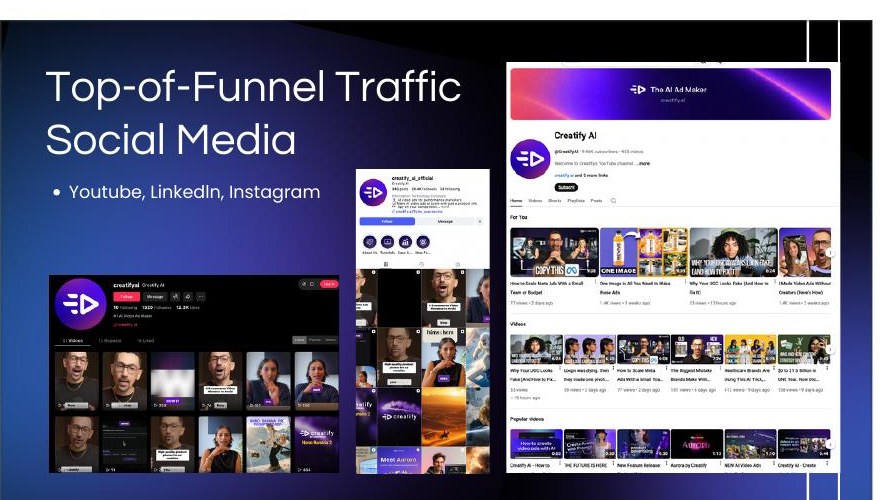
InVideo's TOFU strategy is more concentrated. YouTube is the engine: roughly 56% of the company's social traffic comes from tutorials covering "how to start a faceless YouTube channel," "how to make money with AI video," and similar high-intent creator queries. The TikTok and Instagram presences are smaller, and Instagram in particular is underutilized given that InVideo is a visual product.
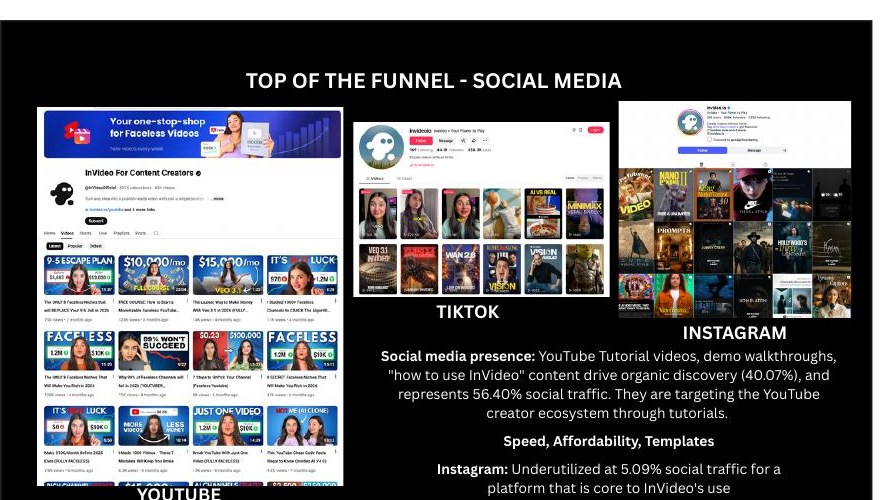
The other half of InVideo's TOFU is SEO. Their blog and help center target high-intent search terms like "AI video generator" and "text to video free." Roughly 40% of the company's traffic is organic search. The SEO strategy is converting at scale, not just generating impressions.
5. Traffic data and sources
Creatify drew roughly 2.8M total visits over a recent three-month window per Similarweb, with about 936K monthly visits. The split: 43% organic search, 34% direct, 15% paid. Bounce rate is 39.6%, which is solid for a SaaS site. Top geographies are the US, India, and Indonesia.
InVideo operates at roughly 8x Creatify's traffic. 7.583M monthly visits, a global rank of #5,603, and a 38.2% bounce rate. The geography is led by India, the US, and Brazil.
The scale gap between the two companies, and against their actual competitors, is much clearer in a chart than in a table:
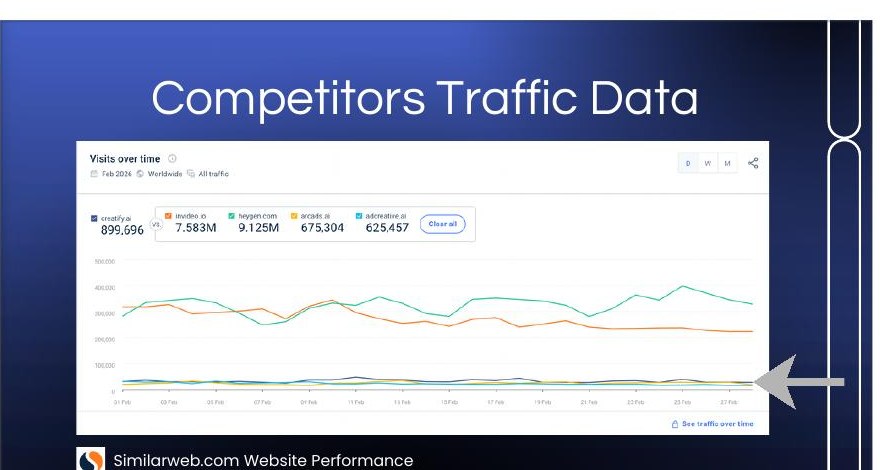
Creatify is in the same neighborhood as arcads.ai and adcreative.ai (its closest B2B competitors). InVideo and HeyGen operate in a different weight class entirely. They look like competitors on a market map. In practice, they serve different buyers at different scales.
One thing worth flagging on InVideo specifically: 95.4% of its referral traffic comes from a single source, AI chatbots, mostly ChatGPT.
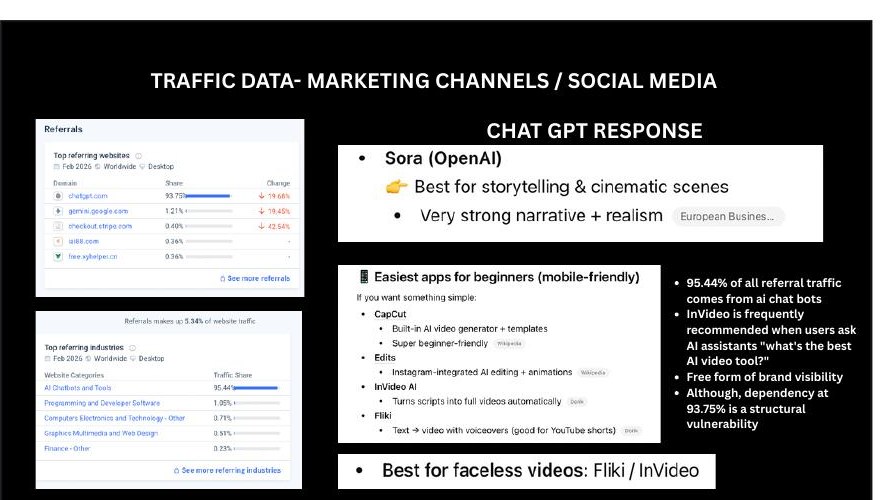
The platform is frequently recommended when users ask AI assistants "what's the best AI video tool?" That is free brand visibility. But a 95% dependency on a single referral channel is a structural vulnerability. If OpenAI changes how it surfaces tool recommendations, a meaningful slice of InVideo's free acquisition could disappear overnight.
6. What is unique, and what is missing?
Creatify's strengths are its founding team (Ex-Meta, FAIR, and Snap engineers), its $9M ARR in 18 months, and the credibility of a Jeffrey Katzenberg backing.
Its gaps are clear ROI metrics on the homepage, transparent enterprise pricing, and direct competitor comparisons. The current hero is a strong promise, but pairing it with specific ROAS or CTR lift from existing customers would close the credibility gap B2B SaaS buyers expect.
InVideo's strengths are its exclusive bundled access to Sora 2 and VEO 3.1, a polished native mobile app, a 5,000+ template library, and a free tier generous enough to drive 60K+ daily signups.
Its gaps are buried social proof, no real-time team collaboration (no multi-user editing like Canva or Figma), and an underplayed Sora 2 + VEO 3.1 partnership. That partnership is their biggest competitive moat, and it is hiding in subpages.
What I am taking from this analysis
Almost nothing about a startup's website is independent of who it serves. Pricing tiers, hero copy, CTA design, social channel mix, and even the geography of the user base are all downstream of one upstream decision: who, exactly, is this for?
For the next phase of this class, my team is working on a marketing plan for Ansera.ai, an AI answer engine for content-heavy websites. Before any decision about messaging or channel mix, the question that has to be answered first is the simplest and the hardest: who, exactly, is this for? Get that right, and the rest of the plan starts to write itself.
This analysis was completed as part of ENTR 2303, Marketing Strategies for Startups, taught by Professor R. Paul Singh at the D'Amore-McKim School of Business, Northeastern University. Team: Lissandra Ferrante, Avinash Vinod, Sarya Mirghani, and Travis Peng. Traffic data sourced from Similarweb.
Comments
Loading comments…